← Back

Auper 600 CE charging on a type 2 wallbox
In 2026, the Brazilian electric motorcycle market continues its accelerated expansion: registrations grew by 47.26% in the first quarter of the year, jumping from 3,453 to 5,085 units, according to data from Fenabrave. With the heated sector, the battery swapping model has once again gained traction in the conversation about electric motorcycles in the country.
It makes sense to ask why Auper did not follow this path, and the answer comes from a decision of engineering, business, and sustainability. We evaluated the swapping model, also called swap, in the initial development phase of the 600 CE and even built prototypes to test the proposal in practice. Still in the prototyping stage, we understood that it would not be the best path, and in this article we will share more about the reasons why.
The origin of battery swapping
The swapping model was born out of a limitation. Many electric motorcycles and scooters use batteries with low power density, which results in recharge times of 5 to 8 hours. Instead of solving this problem at its source, by designing a battery capable of charging fast, part of the industry created swapping stations as the only possible solution: if the motorcycle's motor does not require a high-power battery, swapping the physical pack for another already charged one solves the time problem, although without solving the technical problem.
This decision has a significant cost not only technically, limiting the vehicle, but also logistically and financially. It requires its own logistics network, intensive maintenance of batteries in circulation, and there is little standardization among manufacturers, which hinders the scale of the model as a whole. Even in markets where battery swapping is more mature, such as India and China, standardization efforts still depend on public policy to advance: India's Ministry of Power published battery swapping guidelines only in 2025, and NITI Aayog (National Institution for Transforming India) continues working on a national interoperability policy among manufacturers, according to Bolt.Earth. Without this kind of coordination, each swapping network operates in isolation, with its own batteries, its own stations, and its own cost structure.
What can be observed in the market
This difficulty in scaling shows up in the numbers of those who have already tried on a large scale. Gogoro, the world's largest electric motorcycle battery swapping operator, closed 2025 with a net loss of $80.8 million, even with an improvement compared to the $122.8 million loss in 2024, according to the financial results disclosed to the SEC. In December 2025, Ample, a fast battery swapping company backed by Stellantis, filed for bankruptcy in the United States six months after launching a pilot fleet in Madrid, according to Electrek. And even NIO, the Chinese manufacturer that owns the swapping network considered the most mature in the industry, recorded a loss of more than $840 million in the first quarter of 2025 alone, according to CarNewsChina.
The contrast appears on the other side of the coin. Tesla closed 2025 with its Supercharger network in profit, even in a year of declining automotive revenue, and reinforced growth by opening the network to other car brands starting in 2024, a move that only works when infrastructure is built on an open standard, the same path that Auper follows with the Type 2 connector, according to EV Infrastructure News. In the world of electric motorcycles, Ather, an Indian scooter manufacturer, chose not to do battery swapping and built the Ather Grid, the world's first dedicated fast-charging network for two-wheelers. Today it already has more than 4,300 charging points, with the company gaining market share and reducing losses quarter after quarter, according to its most recent financial results.
2x higher depreciation and unknown risks
The battery is the most expensive and sensitive component of an electric motorcycle. In the swapping model, it leaves the hands of the manufacturer and starts circulating among different users, with no fixed owner and no real control over how it was used before it reached you.
This is more serious than it seems at first glance. Each time you swap your battery at a station, you get back a battery with a history you don't know: it may have been dropped, exposed to excessive heat, or abused by another rider. Swapping your battery at a station means putting a critical safety component on your motorcycle with an unknown history, potentially putting you at risk.
This wear and tear shows up in the numbers too. Batteries from swapping stations depreciate at about 33% per year, more than double the rate of charging equipment for a fixed battery (15% per year), because constant handling and shared use shorten the lifespan of each cell. And because each swapping station needs to maintain an inventory of spare batteries, the model as a whole requires manufacturing more battery units than would be necessary if each motorcycle charged its own.
Greater environmental impact
Manufacturing a lithium-ion battery has a measurable environmental cost even before it leaves the factory. The extraction and refining of lithium, cobalt, and nickel account for the majority of each pack's carbon footprint, between 59 and 115 kg of CO2 per kWh of capacity, according to a study published in Nature Communications in 2024. Every extra battery manufactured carries this cost, regardless of where it goes.
The swapping model manufactures extra batteries for two reasons. First, because each station maintains an inventory of spare batteries in addition to those already circulating in the motorcycles, meaning more units produced to serve the same number of riders. Second, because faster depreciation, 33% per year compared to 15% for the fixed battery, means replacing this entire stock in much less time. The result is more mineral extraction, more carbon emissions during manufacturing, and more batteries reaching the end of their useful life sooner, to deliver the exact same mobility service.
The investment in swapping infrastructure is 7.5x higher
This environmental cost has a financial parallel that is also significant. Our team of experts simulated both models on the same scale: 1,500 fast-charging points versus 1,500 swapping stations, serving the same base of 15,000 users, with an average daily use of 100 km per motorcycle. Setting up the swapping network would cost about R$ 33.7 million, compared to R$ 4.5 million for the same number of fast-charging points, an investment 7.5 times higher to serve the exact same people.
The math also doesn't add up in the final result. With projected annual revenue virtually equal in both models, the fast-charging network closes the first year with a profit of R$ 5.6 million, while the swapping network closes the same period at a loss, a negative R$ 35 million, even while operating at a higher utilization rate.
These calculations considered 10 batteries per swapping station, where each motorcycle would use 2 batteries. The applied electricity cost was R$ 0.66/kWh in both scenarios.
Why fast charging makes sense for Auper
Auper developed the entire propulsion system of the 600 CE in-house, which allows the entire vehicle to be designed around a charging and power goal from the very first drawing, not as an afterthought. It is this in-house engineering that supports charging from 0 to 80% in 30 minutes.
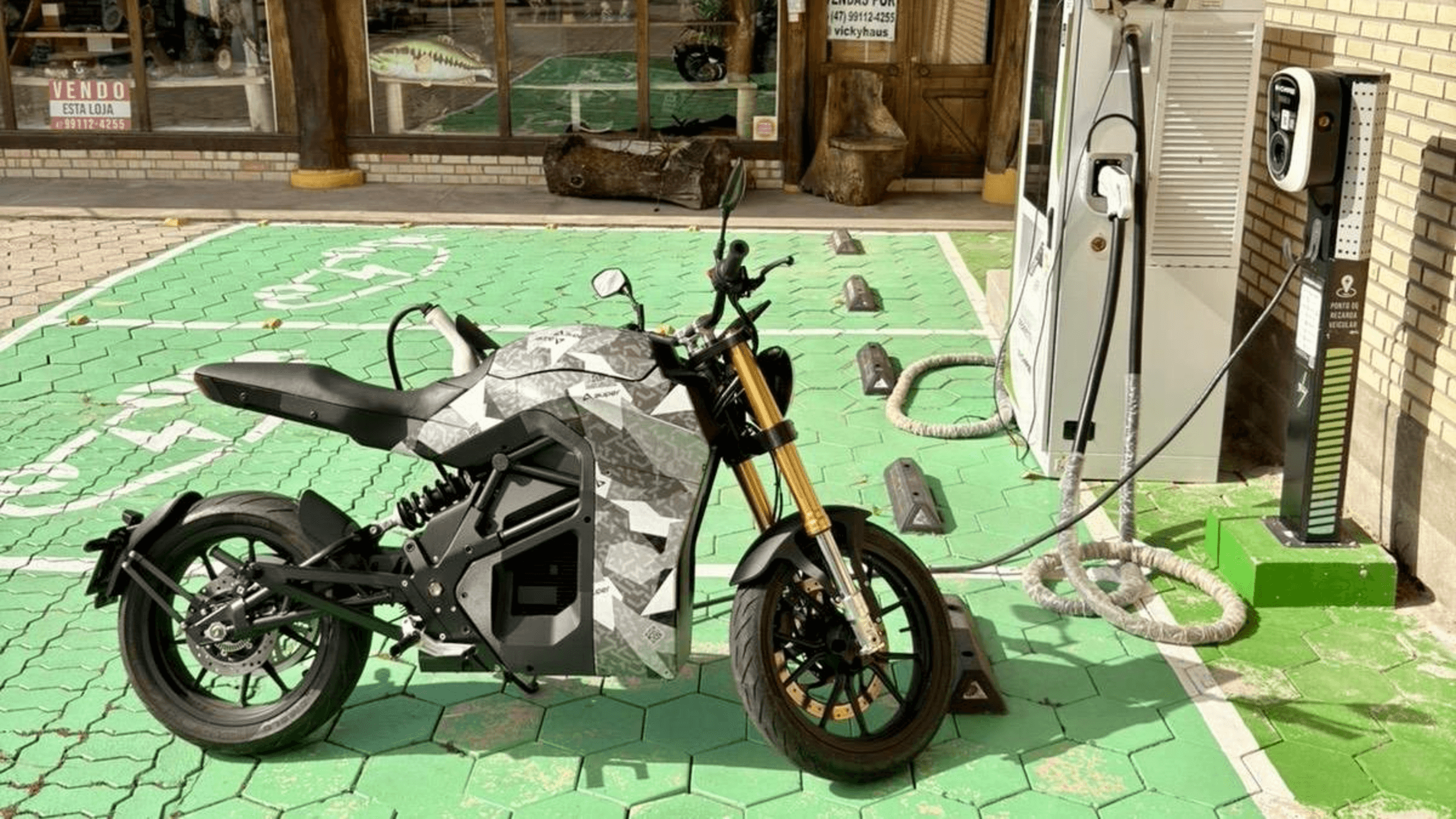
Auper motorcycle charging at a Type 2 car station
This performance does not depend on proprietary infrastructure. The 600 CE charges using the Type 2 standard, the same one already used today in electric cars and available in residential and public chargers across the country. In May 2026, Brazil already had 25,455 public and semi-public charging points, a growth of 20.9% in three months, with fast-charging points advancing 32.8% in the same period, according to a survey by ABVE and the Tupi platform, published by CNN Brasil. Every new charger installed in the country now serves any Auper motorcycle on the road. In a proprietary swapping network, each new station only serves those who have that specific battery.
Understanding the Brazilian market is necessary
This is not to say that battery swapping doesn't work anywhere. In markets like India and China, the model grows supported by standardized fleets of very high utilization, app and shared delivery motorcycles, where the battery is already treated as an asset of the operation, rather than of the individual rider. The global battery swapping market for electric motorcycles and three-wheelers is expected to grow from $1.46 billion in 2025 to $22.72 billion by 2035, driven mostly by this type of fleet, according to MarketsandMarkets.
However, the profile of motorcycle buyers in Brazil is different: motorcycles up to 160 cc account for most of the sales in the country, purchased mostly by a single owner, whether for daily commuting or as a work tool for independent delivery riders, with growing space also for motorcycles up to 300 cc, according to a survey by Carnow. For this buyer, recharging at home or at a public point, at the speed the vehicle itself allows, solves the problem without depending on a closed network of swapping stations. Furthermore, the technical limitation of the vehicle, which is the root problem and the origin of the swapping system, is 100% resolved - which is even more important in the Brazilian riding scenario considering terrains, altimetry, weather conditions, among others.
It was to serve this buyer that Auper developed the 600 CE from scratch, without importing a ready-made project from another market. Every engineering decision, from the battery to the charging, started from the certainty that the motorcycle needed to respond to the reality of those who ride motorcycles in Brazil. A motorcycle made by Brazilians, for Brazilians.
